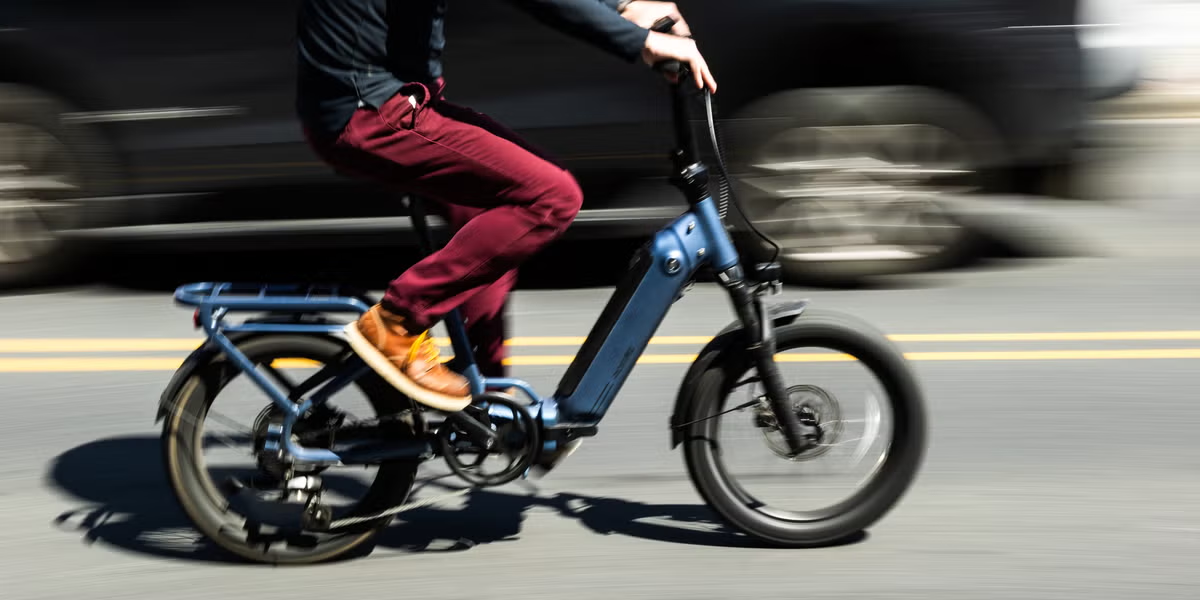
bikesport.biz.id – Summer’s here, and that means more folks are hitting the road and trails on electric bikes. With gas prices still on the rise, e-bikes are becoming a super popular choice for daily commutes, getting around town, and even just running errands. Whether you’re cruising your local bike paths for fun, tackling rail trails with the family, or zipping through city streets, 2026 is a fantastic year to snag an e-bike.
Seriously, there are a TON of awesome electric bikes out there right now, and if you know where to look, you can find some pretty sweet deals. No matter your budget or what you plan to do with your e-bike – from zipping to work to shredding mountain trails, or if you’re a seasoned cyclist or just starting out – there’s an e-bike out there for absolutely everyone.
How We Pick the Best E-Bikes
Here at Bicycling, our team of editors is obsessed with bikes. We spend our year testing tons of electric bikes across every single category you can imagine, and we’re always getting new models to check out. Plus, we regularly chat with cyclists of all ages and skill levels about what they need and want in a ride. This helps us put together our definitive list of the Best Electric Bikes – the ones that are going to serve you well on the street, on the trails, and just cruising around your neighborhood.
Our Top Tip for New Buyers: While you definitely don’t need to spend a fortune to get a great-riding e-bike in 2026, try to spend what you’re comfortable with. An e-bike that feels good to ride is a joy to use, and you’ll end up riding it way more often. It’s almost always cheaper to buy an e-bike kitted out the way you want it from the get-go than to try and upgrade it later. And a crucial point: you can’t really swap out the motor or battery if you decide you want more power down the line, so choose wisely upfront!
Best Overall E-Bike: Aventon Level.4 REC
The Aventon Level.4 REC is our current benchmark electric bike, and for good reason. It’s an absolutely stellar e-bike for commuting, running errands, or just leisurely rides. Over the years, the Level platform has proven itself to be super reliable and low-maintenance, all while keeping its price tag pretty reasonable.
For 2026, the Level.4 has been smartly split into two distinct models. The REC we’re highlighting here rocks a robust 750W hub motor with a healthy 80Nm of torque. Aventon also added regenerative braking, which is a neat trick that can actually boost the bike’s range by up to an impressive 75 miles. If you’re looking for even more grunt, the pricier ADV edition packs a mid-drive motor pushing a massive 100Nm of torque and boasts a whopping 110-mile range. Both versions come fully loaded out of the box with essential commuter gear like fenders, a rear rack, integrated lights, and a comfortable suspension fork.
Smart Features for the Modern Rider
One of the coolest things about the Level.4 is its connected features, thanks to the Aventon Control Unit (ACU). This smart little system adds a bunch of useful tech to an already well-equipped bike. You get a built-in wheel lock and motion sensor alarm, which are great passive deterrents if you stop for a quick coffee or pop into the post office. The real game-changer is the 4G chip inside the ACU, which enables GPS tracking right in Aventon’s mobile app. This means you can actually locate your bike if you happen to forget where you parked it!
This 4G connectivity also allows you to set up geofence restrictions, which can be super handy if you’re lending the bike to teens or housemates. You can set a virtual boundary, and if the bike leaves that area, you’ll get an alert. It’s peace of mind in your pocket!
Lectric ONE: Pinion Drivetrain at an Unbeatable Price
A major draw for the Lectric ONE is its inclusion of a Pinion drivetrain. Pinion’s high-end, fully enclosed gearboxes are usually found on super expensive, niche bikes, so seeing one on a $2,400 commuter e-bike is pretty darn exciting. It’s a component usually reserved for bikes costing three times as much!
During our testing, we were seriously impressed with the Pinion system’s smooth feel and spot-on precision, and Lectric’s hub motor also held its own. While the improved cadence sensor was better than others we’ve encountered, Test Editor Dan Chabanov did note that, like most cadence sensor-equipped bikes, the ONE can feel a bit disconnected from the motor, a little unnatural. He explained, “This feeling comes from a combination of slight lag and because the force you put into the pedals doesn’t directly translate to the motor’s output.”
Still, it didn’t take Chabanov long to get accustomed to how the ONE delivers its motor assist. Overall, the ONE is an ideal choice for riders looking for a dependable, low-maintenance, all-weather commuter bike that comes loaded with premium features typically found on much pricier models.
Ride1Up Portola: Mighty Mini for Maximum Value
For the price, it’s genuinely tough to beat the Ride1Up Portola. This mighty mini e-bike packs everything you need for quick commutes: power, speed, comfort, and portability. Even though it costs thousands less than some high-end folding electric bikes, it still manages to deliver a premium feel and ride quality.
The bike itself is incredibly solid; we’ve put several hundred miles on the Portola, and the only maintenance it’s needed is topping up the tire pressure and a bit of chain lube. Runner’s World’s Runner-in-Chief, Jeff Dengate, has been testing the Portola for months and notes, “It’s the perfect size for city commuting and doesn’t take up space in my garage when I’m not riding it.”
Under the hood, the Portola features a 750-Watt motor with 65 Nm of torque, which is plenty of juice to get you up even the steepest hills around town. The motor is powered by a 500Wh internal battery, offering a range of up to 40 miles. If you need more juice or weigh over 200 pounds, you can opt for the larger 643Wh battery. Ride1Up equips the Portola with an integrated rack, a suspension fork, lights, and fenders. Plus, it boasts hydraulic disc brakes – a feature not always found on folding e-bikes in this price bracket – making stopping the nearly 60-pound bike much safer and more controlled.
Aventon Current ADV: Trail-Ready Full Suspension E-MTB
While it’s the priciest bike on our list, the Aventon Current ADV justifies its cost with exceptional performance for its category. Many electric bikes might look like mountain bikes, but they aren’t always built for true off-road use. Aventon’s new Current ADV, however, is the brand’s first full-suspension E-MTB, offering genuine trail-ready performance right out of the box.
Trevor Raab, Bicycling’s Senior Photographer and Test Team member, praised its ride feel, saying, “The bike’s intuitive ride feel will please experienced mountain bikers and also benefit first-time mountain bikers.” The Current ADV boasts an aluminum frame with 140mm of rear-wheel travel and a fantastic motor that delivers 750 peak Watts and 110Nm of torque. It even has a Boost mode that bumps power to 850W and 120Nm of torque for those extra challenging climbs!
Rounding out the ADV’s impressive spec sheet are high-end components like a RockShox Psylo Gold fork, SRAM DB8 brakes, and a SRAM Eagle 70 Mechanical transmission. It also comes with a tubeless wheelset wrapped in Maxxis Minion EXO tires, ready for whatever the trail throws at you. In his full review, Raab particularly highlighted the Current’s user-friendly interface, loaded with ride data and the ability to fine-tune motor settings. If you don’t need rear suspension, check out Aventon’s updated Ramblas ADV hardtail E-MTB as a great alternative.
Velotric Tempo: Lightweight Champion
The term “lightweight e-bike” might sound like an oxymoron, especially when many electric bikes tip the scales at 60 or even 80 pounds. However, a bike weighing under 40 pounds is seriously impressive. Even more so when many of these lighter e-bikes come with a hefty price tag. The recently released Velotric Tempo, however, costs just $1,499 and boasts a claimed weight of only 39 lbs!
Velotric achieves this impressive weight reduction by ditching the bulky suspension fork (let’s be honest, suspension forks on lower-priced bikes often don’t perform that well anyway), swapping heavier tires for nimble 700x42c gravel tires, and utilizing a smaller battery. Riders who need to carry their bike up stairs or load it onto a bike rack will absolutely love the reduced weight. However, heavier riders might want to test ride the Tempo before purchasing, as lower-powered motors can sometimes bog down and reduce battery range for bigger-bodied individuals.
Aventon Soltera & Soltera.3: Simple, Stylish, and Smart
This relatively affordable seven-speed model from Aventon delivers a simplicity and style that’s tough to beat. It’s actually even better than the original version, thanks to the addition of hydraulic disc brakes. Just push the throttle to get going, and the brushless hub motor kicks in, smoothly assisting you as you start pedaling.
Along with its reliable disc brakes, the Soltera features integrated lights and turn signals for added safety and visibility. The battery is cleverly hidden within the bike’s frame, a surprising feature considering the more “bolt-on” aesthetic of many bikes in this price range. Best suited for smoother roads and bike paths, the Soltera packs all the essential features a city rider needs into a strikingly light 46-pound package.
Aventon Soltera.3: The Ultimate Singlespeed Experience
Many riders absolutely love singlespeed bikes for their sheer simplicity. Without derailleurs and multiple gears, there are simply fewer parts to break down or require maintenance. That’s precisely why singlespeeds are a favorite among riders in cities, on college campuses, and for many commuters.
The Soltera.3 really embodies the K.I.S.S. (Keep It Simple, Stupid) mantra in electric bike form. It doesn’t have a suspension fork that adds unnecessary weight, nor does it have gears; it doesn’t even have a traditional chain! Instead, the Soltera.3 utilizes a singlespeed Gates Belt Drive – it’s clean, lightweight, and incredibly low-maintenance. The only real downside to singlespeed bikes is that they can be tougher to ride in hilly areas. Even with the Soltera’s motor assist, you might find yourself walking up steeper inclines more often than you would on a multispeed bike.
Radio Flyer Flyer Loop: Family Fun Redefined
Most families know Radio Flyer for their iconic red wagons, tricycles, and fun ride-on toys, but did you know the company also makes a range of electric bikes? They introduced their first family-oriented e-bike, the Via, a few years back and have since expanded their e-bike lineup to five models. The all-new Flyer Loop recently arrived at our office, and it’s an impressive package indeed.
This 20-inch wheel mid-tail model is equipped with a robust 750W hub motor (87Nm torque) and is designed to carry up to two children as passengers. And like any good family bike should be, the Flyer Loop is loaded with safety features. These include a fully enclosed rear wheel guard, a long front fender for splash protection, turn signals for clear communication, and powerful four-piston Magura hydraulic disc brakes for reliable stopping power. Flyer offers the Loop in one universal frame size that fits riders from 4’11” to 6’3″, and it comes in four attractive color choices.
Conveniently, racks, fenders, and lights are all standard equipment, making it ready for family adventures right out of the box.
How to Choose the Right E-Bike for You
Picking the perfect electric bike can feel a bit overwhelming with so many options available. It’s important to think about how you’ll be using the bike most often. Will it be for daily commutes, leisurely weekend rides, hauling groceries, or hitting off-road trails? Your primary use case will heavily influence the type of bike you should consider.
Consider the terrain you’ll be riding on. If you live in a hilly area, you’ll want a bike with a powerful motor and good torque. For flatter city riding, a lighter bike with a more modest motor might be perfectly sufficient. Also, think about the desired range – how far do you typically ride on a single charge? Battery capacity is key here, and manufacturers usually provide estimated ranges, though real-world performance can vary.
Key Features to Consider
When you’re comparing different e-bikes, pay attention to a few key specifications. Motor type (hub vs. mid-drive) can affect the ride feel and power delivery. Hub motors are often found on more budget-friendly bikes and provide a direct push, while mid-drive motors offer a more natural pedaling sensation and better weight distribution, especially for climbing. Battery capacity, measured in Watt-hours (Wh), directly impacts your range.
Brake type is also crucial for safety. Hydraulic disc brakes offer superior stopping power compared to mechanical disc brakes or rim brakes, especially in wet conditions. Suspension (front fork, rear shock, or full suspension) adds comfort, particularly on rough terrain. Finally, consider accessories like racks, fenders, and lights, which can significantly enhance the practicality and versatility of your e-bike for everyday use.
The Future of Electric Bikes in 2026
The electric bike market is constantly evolving, and 2026 is shaping up to be an exciting year for innovation. We’re seeing advancements in battery technology leading to longer ranges and faster charging times. Motors are becoming more powerful and efficient, offering a smoother and more responsive ride experience.
Smart features, like those found on the Aventon Level.4, are becoming more common, integrating GPS tracking, anti-theft systems, and connectivity with mobile apps. Expect to see more specialized e-bikes catering to niche markets, such as lightweight gravel e-bikes and robust cargo e-bikes designed for hauling families or goods. The overall trend is towards more refined designs, improved performance, and greater integration of technology, making e-bikes an even more compelling transportation solution for everyone.
Frequently Asked Questions (FAQ)
Q: What is the typical range of an electric bike in 2026?
A: The range of electric bikes in 2026 can vary widely, but most reputable models offer between 30 to 60 miles on a single charge under ideal conditions. Factors like battery size, rider weight, terrain, and assist level significantly influence actual range. Some high-end models with larger batteries can even exceed 100 miles.
Q: Are electric bikes worth the investment?
A: For many, yes! Electric bikes can be a cost-effective alternative to car ownership, saving money on gas, insurance, parking, and maintenance. They also offer health benefits, encourage outdoor activity, and reduce environmental impact. The initial investment can be significant, but the long-term savings and lifestyle improvements often make them well worth it.
Q: Do I need a special license to ride an electric bike?
A: In most places in the US, you do not need a special license to ride an electric bike that meets certain class definitions (typically Class 1, 2, or 3, with speed and motor limitations). However, regulations can vary by state and even by city, so it’s always a good idea to check your local laws and ordinances before riding.
Q: How much maintenance do electric bikes require?
A: Electric bikes require similar maintenance to traditional bicycles, with the addition of looking after the battery and motor system. Regular checks on brakes, tires, chain, and gears are essential. The battery should be stored properly and charged according to manufacturer instructions. While motors and batteries are generally low-maintenance, it’s wise to have them inspected periodically by a qualified technician.